

 Manage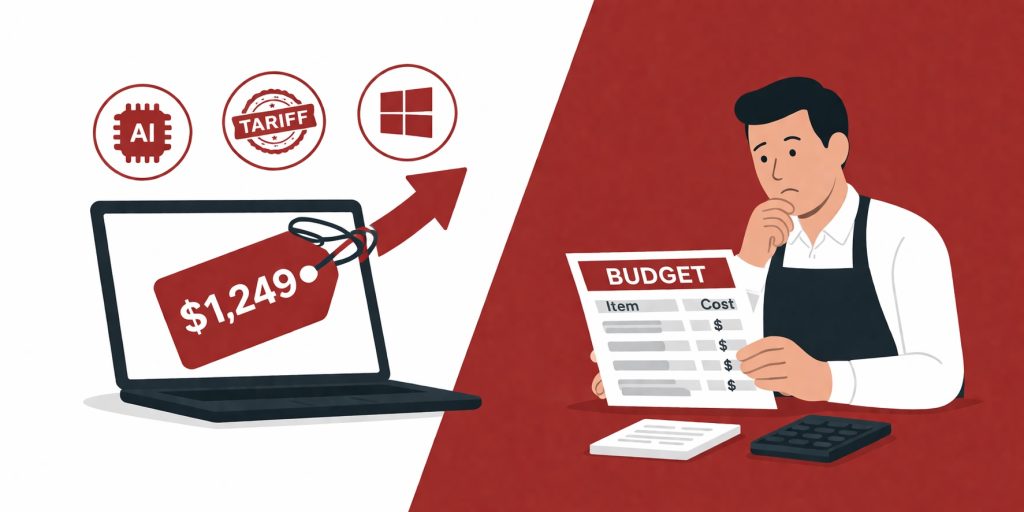
If you’ve priced out laptops or desktops recently and felt sticker shock, you’re not imagining it. Hardware that cost your business $800 per device two years ago is now pushing $1,000 or more — and vendors can’t even commit to stable pricing. Three converging forces are driving the most volatile PC market in years, and understanding them is the first step to making smarter buying decisions for your business right now.
The Numbers Don’t Lie — How Much Prices Have Actually Gone Up
This isn’t a minor adjustment. Research firm IDC projects PC prices will increase by 20 percent in 2026. For the budget end of the market — the $400–$600 laptops that small businesses have long relied on for administrative staff — analysts are projecting increases as high as 25% for budget models, compared to around 15% for premium devices.
That pricing asymmetry matters. The machines your business depended on to keep costs down are being hit the hardest.
At the component level, the story is even more dramatic. TrendForce found that memory components such as DRAM and SSD storage have surged in price, growing from about 15% of a laptop’s bill of materials to more than 30% after several quarters of increases. When nearly a third of what a laptop costs to build is just RAM and storage, prices have nowhere to go but up.
With the RAM required for Windows 11 and Copilot+ now being much costlier, the price increase and scarcity in supply makes it difficult to deliver sub-$600 laptops without compromising user experience, according to IDC analyst Neha Padhi. For small businesses, that effectively kills the budget-laptop tier.
Force #1 — The AI Memory Crisis
The single biggest driver of rising PC prices has nothing to do with the PC market itself — it’s the AI boom.
AI data centers require enormous quantities of high-bandwidth memory (HBM) to run large language models and GPU clusters. Memory manufacturers, sensing far higher profit margins in data center chips, have shifted production capacity away from consumer DRAM and NAND storage. AI data centers are consuming a large share of high-bandwidth memory production, leaving fewer chips available for consumer PCs — an imbalance pushing costs upward across laptops, desktops, and upgrades.
The downstream effects are severe. The cost of DDR5 RAM saw dramatic increases, with some 32GB kits tripling in price from $90 in September 2025 to $349.99 by late 2025. And the supply isn’t coming back anytime soon — Crucial, a major RAM brand, stopped selling memory to consumers entirely and focused exclusively on data centers.
Memory prices are expected to continue rising, with some projections indicating a 50% to 55% increase in Q1 2026 compared to Q4 2025. For a small business planning a hardware refresh, this is the core problem: the component your devices need most is being rationed away from the consumer market.
Force #2 — Tariffs Are Compounding the Problem
Even before the memory crisis, tariff policy was already pushing prices higher — and the two forces have stacked on top of each other.
Many PC components come from overseas suppliers, and PC vendors can’t simply absorb all the tariffs imposed on them, according to Jack Gold, principal analyst at J. Gold Associates. Most laptops and desktops are assembled in Taiwan or China, placing them directly in the path of import tariffs that have been in flux since 2025.
The impact is already showing up in manufacturer announcements. Acer’s CEO announced a flat 10% price increase on its laptops to counteract tariffs on Chinese imports, and prices from other brands have been creeping up much faster than usual. Other vendors have been less transparent but equally aggressive.
The modeling from industry groups is stark. A report by the Consumer Technology Association predicted laptop prices could increase by roughly 45%, or about $357 on average, under some tariff scenarios. Even the more conservative projections put the increase well above normal inflation.
There’s a currency factor layered on top of this. The US dollar declined approximately 9% against other major currencies in 2025 — and when PC hardware is priced globally in dollars, a weaker dollar means higher import costs that manufacturers eventually pass to buyers.
Force #3 — The Windows 10 End-of-Life Demand Spike
The third force is one many small business owners created themselves — and the timing couldn’t have been worse.
Support for Windows 10 ended on October 14, 2025. Microsoft no longer provides software updates, security fixes, or technical assistance to Windows 10 PCs. That deadline drove a massive wave of business hardware refreshes throughout 2025. PC shipments grew by 9.1% to 270 million units in 2025 compared to 2024, driven by the Windows 10 end-of-life deadline and a rush to upgrade before tariffs took effect.
That demand surge collided head-on with the memory shortage. Businesses flooding the market with refresh orders at the exact moment RAM supplies tightened created a pricing spike across every category.
There’s also a specs problem baked into the upgrade itself. Windows 11’s Copilot+ requirements set a higher RAM baseline than most older hardware could meet, meaning businesses couldn’t just upgrade the OS — they had to buy new machines that require the very memory now in short supply.
Roughly 35% of desktop users worldwide are still running Windows 10 as of early 2026 — meaning a significant portion of the business refresh wave is still ahead, not behind us. Demand pressure is not going away.
What This Means for Your Business Budget Right Now
The practical implication of all three forces converging: plan to spend more, and plan strategically.
Budget 20–25% more per device than your last refresh cycle. A fleet that cost $30,000 to refresh in 2023 should be planned at $36,000–$37,500 today. That’s not a vendor upsell — it’s the market.
Don’t wait for prices to fall. Even if underlying component markets soften later, end-customer pricing tends to normalize slowly — OEM and channel prices typically do not revert quickly. Waiting for relief that may not arrive until late 2026 or beyond while your hardware ages is not a safe strategy.
Stick with established vendors for bulk orders. Larger PC vendors like Dell, HP, Lenovo, and Apple are better positioned to manage supply constraints due to economies of scale and stronger negotiating power with suppliers. Smaller or lesser-known brands are more likely to quietly reduce specs rather than raise prices visibly.
Consider certified refurbished hardware for non-intensive roles. For reception staff, data entry, or light office work, a professionally refurbished device from a prior generation at half the price of a new one is a legitimate option. The memory shortage affects new hardware far more than existing inventory.
Finally, phase your refresh rather than refreshing everything at once. Prioritize users on failing hardware or those running security-critical workloads on unsupported Windows 10. Defer the rest until supply stabilizes — and use that time to get quotes locked in before the next round of price adjustments. Not sure which devices to prioritize? A structured hardware audit gives you the answer — here’s how to run one for your business fleet.
The Bottom Line for Small Business Owners
Three forces — an AI-driven memory shortage, compounding tariff pressure, and the Windows 10 end-of-life demand spike — have converged to make 2026 one of the most expensive years on record to buy business PCs. The market won’t reset overnight. The businesses that navigate this best are the ones auditing their fleet now, budgeting realistically, and buying strategically rather than reacting when a machine finally fails.
Start with your hardware inventory today. Identify which devices are failing, which are running unsupported software, and which can safely wait. Then get quotes from at least two major vendors before prices move again.