

 Managed IT Services
Article Summary: A passkey lets you sign in to an app or website using the same fingerprint, face, or PIN you use to unlock your phone or laptop, with no password to type. It’s built on a security standard called FIDO that can’t be phished, because the passkey only works on the real site and there’s no password to steal or reuse. Most major platforms and a growing list of business tools support passkeys, and Microsoft 365 includes them at no extra cost. For most businesses, it’s worth starting to roll them out, beginning with the most sensitive accounts.
Passkeys for business are quickly becoming the smarter way to log in. Instead of relying on passwords your team can lose, reuse, or hand over to a fake login page, passkeys for business let staff sign in with a fingerprint, face scan, or PIN. This guide covers what passkeys are, how passkeys vs passwords compare, whether they’re safe for small businesses, and how to implement passkeys at work without locking anyone out.
Passwords are the weak point in most businesses. People reuse them across accounts, write them on sticky notes, and type them into convincing fake login pages without realizing it.
Passkeys are the technology built to replace passwords, and they fix the parts that cause the most trouble. A passkey lets you sign in with the same fingerprint, face scan, or PIN you already use to unlock your phone or laptop. There’s no password to type, so there’s nothing for an attacker to steal, guess, or trick out of you.
Let’s look at what passkeys are, why they’re so much harder to attack than passwords, and whether your business should start using them.
What are passkeys?
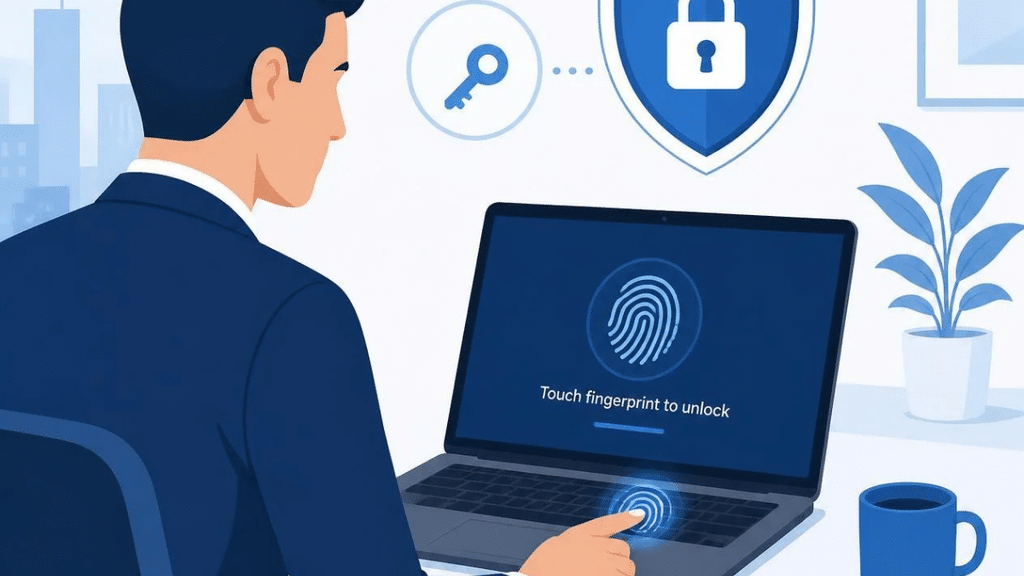
A passkey replaces your password with your device’s own security. Instead of typing a password, you prove it’s you the same way you unlock your phone: a fingerprint, a face scan, or a PIN.
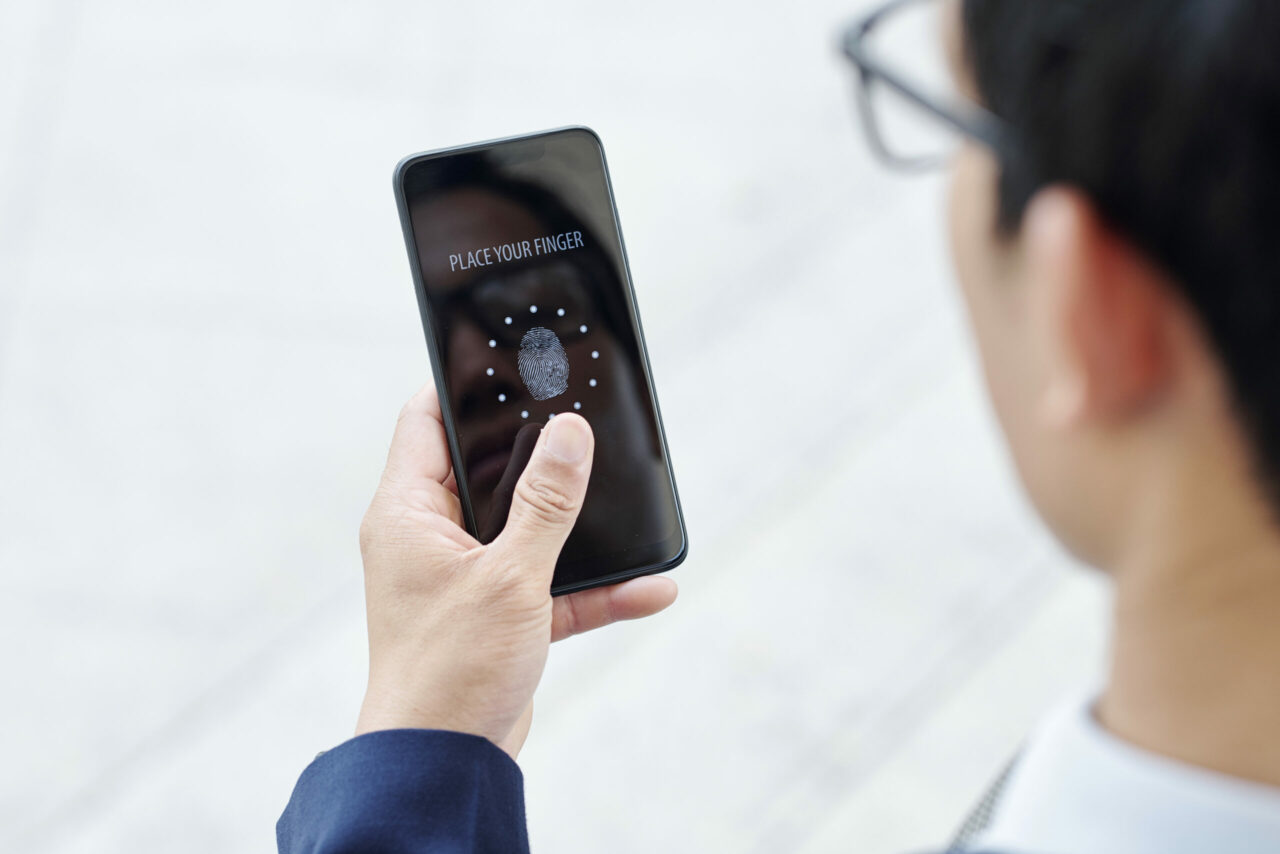
When you set up a passkey for a website, your device creates two matching keys. The private key stays locked on your device and never leaves it. The public key is stored by the website.
When you sign in, the site sends a challenge that only your private key can answer, your device answers it once you confirm with your fingerprint or PIN, and you’re in. The website never sees a password, because there isn’t one. This approach comes from a standard called FIDO, which Apple, Google, and Microsoft all build on. This same FIDO standard is what makes passkeys for business possible across major platforms today.
If you’ve ever wondered what are passkeys in the simplest terms: they’re a login that lives on your device, unlocks with you, and can’t be copied, guessed, or typed into the wrong website.
Passkeys vs passwords: why passkeys are harder to attack
A password is a secret you share with the website every time you log in, and that’s exactly what attackers go after. A passkey has no shared secret. That one difference fixes the biggest problems with passwords.
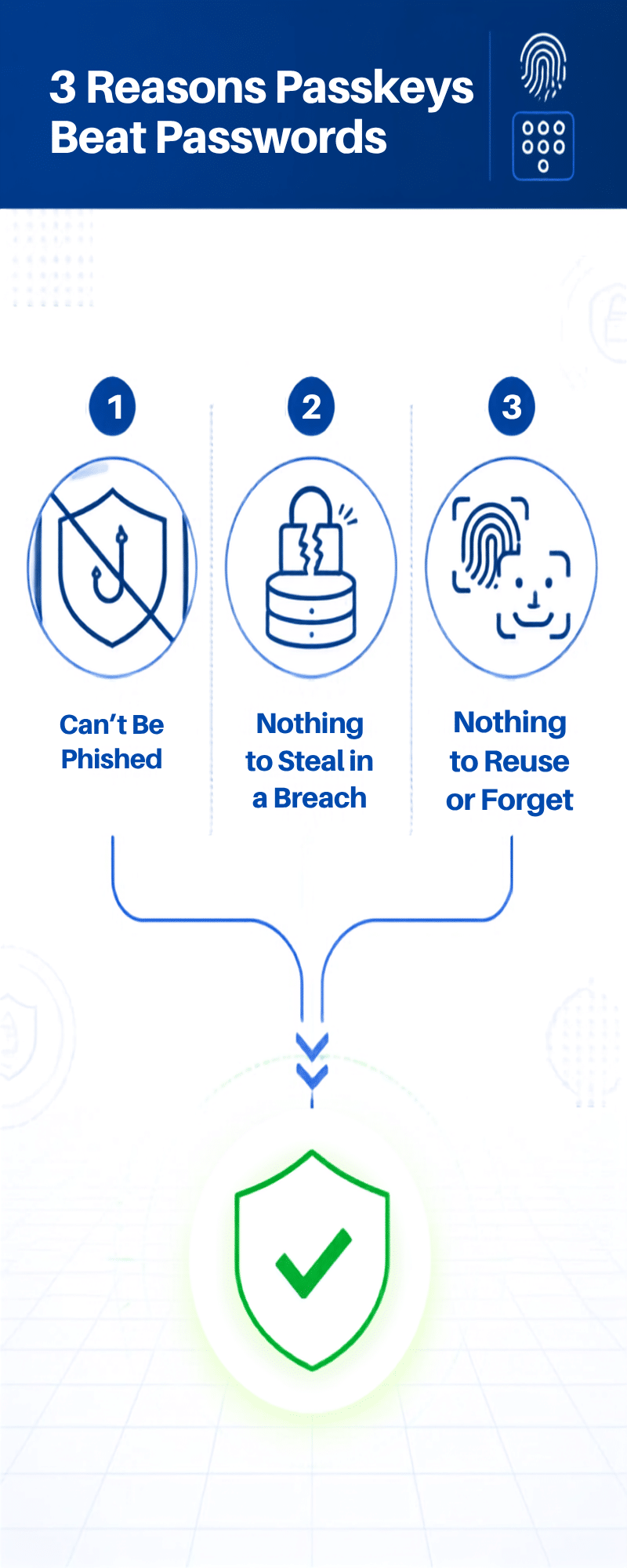
- They can’t be phished. A passkey only works on the real website it was created for. Land on a convincing fake, and the passkey simply won’t work, so there’s nothing to hand over. That matters, because phishing is how most break-ins start.
- There’s no password to steal in a breach. The website only keeps your public key, which is useless on its own. If the company gets hacked, there’s no password list to grab and try on your other accounts.
- Nothing to reuse or forget. Each passkey is unique to one site and made automatically, so reused and weak passwords stop being a problem.
Here’s the passkeys vs passwords comparison at a glance. A password can be guessed, so it has to be long and complex. A passkey can’t be guessed, because there’s nothing to guess. A password can be typed into a fake site. A passkey refuses to work anywhere but the real one. A password sits in a database waiting to be stolen. A passkey’s private half never leaves your device. A password has to be remembered or stored somewhere. A passkey is unlocked by the fingerprint or PIN you already use dozens of times a day.
Older methods like text-message codes and app approval prompts can still be tricked out of people. That’s why phishing-resistant MFA has become the benchmark, and passkeys are the most practical way for a small business to get there.
Phishing-resistant authentication: what it means and why it matters
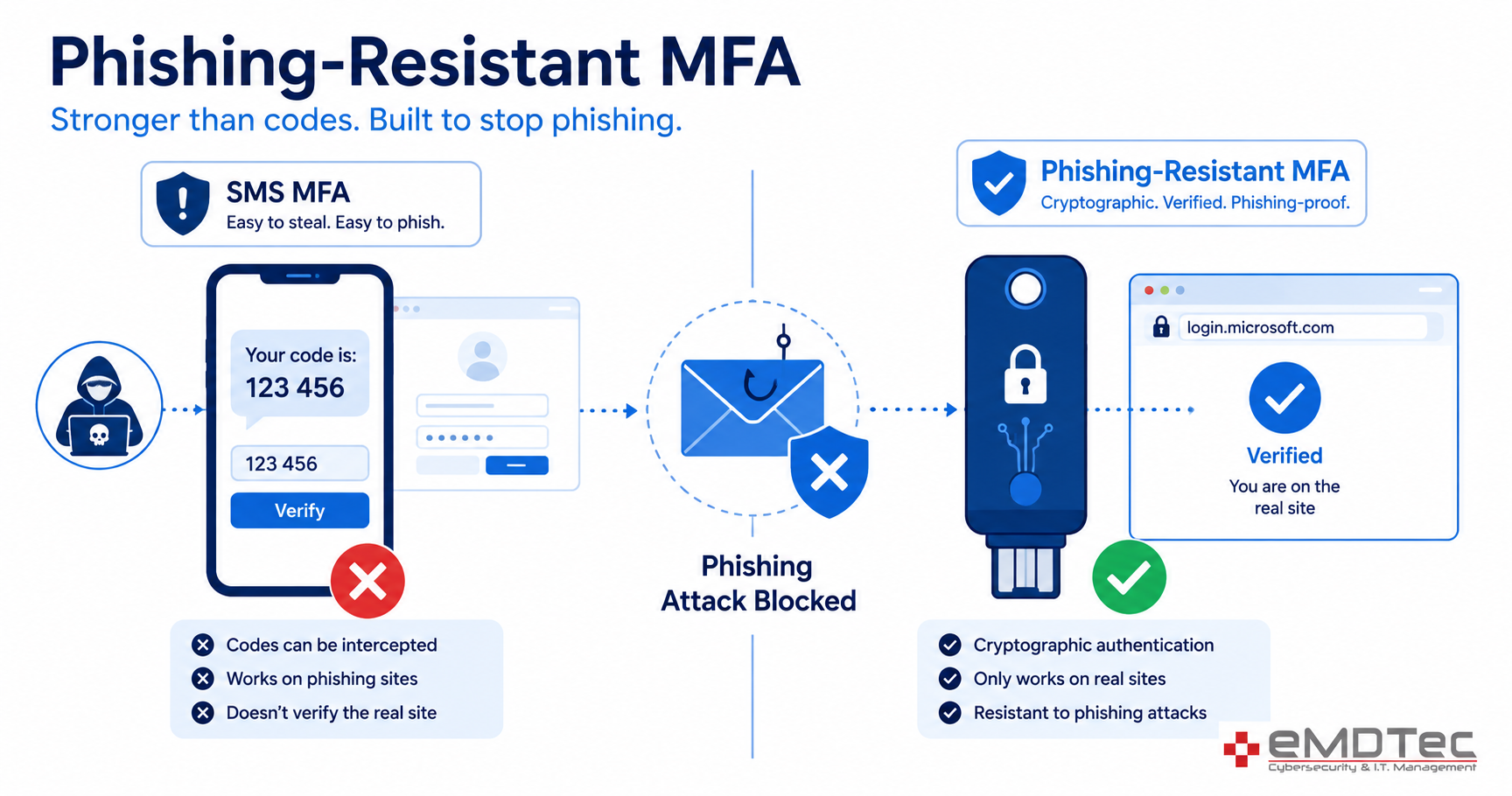
“Phishing-resistant authentication” is a mouthful, but the idea is simple: a login method that still protects you even when an employee is fooled. Most attacks today don’t break encryption. They trick a person into typing a password and a six-digit code into a look-alike page, and the attacker relays both to the real site in seconds.
Phishing-resistant authentication closes that door because there’s nothing for the employee to type. The passkey checks the website’s real address before it responds, so a fake page gets nothing. Security agencies like CISA specifically recommend FIDO-based logins for exactly this reason, and cyber insurers are increasingly asking about phishing-resistant MFA on renewal questionnaires.
For a small business, that’s the real payoff of passkeys for business. You stop depending on every employee spotting every fake email, and you start relying on a login that can’t be handed over by mistake.
FIDO2 security standards, explained in plain English
You’ll see the terms FIDO, FIDO2, and WebAuthn used around passkeys. They all refer to the same family of FIDO2 security standards, published by the FIDO Alliance and the W3C, the group that sets web standards.
In practice, FIDO2 security standards define two things: how your browser or app talks to the website (WebAuthn), and how it talks to the thing holding your passkey, whether that’s your phone, your laptop’s built-in security chip, or a physical security key (CTAP). Because Apple, Google, and Microsoft all implement the same standards, a passkey created on an iPhone works with a Windows laptop’s browser, and a hardware key works across all of them.
Why should a business owner care? Because open standards mean you’re not locked into one vendor, your staff can use the devices they already have, and the security has been reviewed publicly for years rather than being one company’s proprietary trick.
Where you can use passkeys already
Support for passkeys for business has spread fast. You can already sign in with passkeys to Microsoft, Google, and Apple accounts, plus a growing list of banks, password managers, and business tools.
Apple, Google, and Microsoft have built passkeys into their phones, laptops, and browsers, so the device in your pocket can already store and use them. That means rolling out passkeys for business rarely requires new hardware.
There are two types worth knowing. A synced passkey is backed up to your Apple, Google, or Microsoft account, so it works across all your devices and you’re covered if you lose one. A device-bound passkey stays on a single device, like a physical security key you plug in, which is the most locked-down option and a common pick for sensitive accounts.
Passwordless login for business: should your business use passkeys?
For most businesses, passkeys for business are worth it, and you can start small. There’s no need to switch everything overnight or drop passwords on day one. Passwordless login for business is a direction, not a light switch.
If you use Microsoft 365, passkeys are already available through Microsoft Entra. Staff can sign in with a passkey stored in the Microsoft Authenticator app, a security key, or their own device. Google Workspace supports them too.
Passkeys for business are also just faster. Microsoft says signing in with a synced passkey takes about 3 seconds, against roughly 69 seconds for a password plus a traditional MFA code. Across a whole team, that adds up.
Passkeys for small business: SMB cybersecurity without a big budget
Big companies have had hardware tokens and dedicated security teams for years. Passkeys for small business level that playing field, because the strongest login method available is now built into the phones and laptops your team already owns and included in the Microsoft 365 and Google Workspace plans you already pay for.
That matters because SMB cybersecurity usually fails at the login, not at the firewall. Stolen or phished credentials are behind most of the email compromises, fake-invoice scams, and ransomware incidents we see in small businesses. Fixing the login fixes the front door.
Passkeys for small business also simplify a few things owners tend to dread: no more password-reset tickets clogging up the help desk, no more shared spreadsheets of logins, and a much easier answer when your cyber insurance renewal asks how you protect admin accounts. If you’re building out SMB cybersecurity on a limited budget, this is one of the highest-return changes you can make.
How to implement passkeys at work: a step-by-step rollout
Here’s how to implement passkeys at work in a way that keeps everyone working and nobody locked out:
- Inventory your logins. List the systems your team signs into every day and note which already support passkeys (Microsoft 365, Google Workspace, most password managers) and which still need a password.
- Turn passkeys on for your most sensitive accounts first: administrators, finance, and anyone who can move money or change systems. These are the accounts attackers want most.
- Enable the setting in your identity platform. In Microsoft Entra, that’s the passkey (FIDO2) authentication method; in Google Workspace, it’s under the passkeys option for your organization. Your IT provider can switch this on in minutes.
- Run a small pilot. Pick a handful of willing staff, have them register a passkey on their phone or laptop, and use it for a week alongside their normal login. Collect the questions that come up.
- Make sure each person has a backup, like a second device or a security key, so a lost phone doesn’t lock anyone out.
- Let everyone else add a passkey as a faster, safer way to sign in, alongside their normal login at first. Short, in-person walkthroughs beat long emails here.
- Tighten the rules over time. Once passkeys are the habit, require them for the sensitive group, then phase out weaker options like text-message codes. Our post on passkey migration covers the longer-term path to eliminating passwords entirely.
Your IT provider can switch this on and run the rollout so nobody gets locked out along the way. Knowing how to implement passkeys at work is mostly about sequencing: sensitive accounts first, backups before enforcement, and passwords retired last.
Benefits of passkeys for employees (and for business account security)
Security changes usually mean more friction for staff. Passkeys for business are the rare exception, which is why the benefits of passkeys for employees are worth spelling out when you announce the change:
- No passwords to remember or rotate. The fingerprint or PIN they already use to unlock their device is the login.
- Faster sign-ins. A few seconds instead of typing a password, waiting for a code, and typing that too.
- Fewer lockouts and reset tickets. Forgotten passwords and expired codes stop being a daily interruption.
- Less pressure to spot every scam. Even if someone clicks a convincing link, the passkey won’t work on the fake site.
- Works across the devices they already use. Synced passkeys follow them from phone to laptop.
For the business, those same benefits translate directly into stronger business account security. Every account protected by a passkey is one that can’t be phished, credential-stuffed, or brute-forced, which removes the most common way attackers get into company email and cloud systems. Business account security stops depending on individual vigilance and starts depending on math.
What to watch out for
Passkeys for business aren’t magic, and a few things are worth planning for.
- Account recovery. If someone loses the only device with their passkey and has no backup, they can get locked out. A synced passkey or a second registered device fixes this, but you have to set it up ahead of time.
- Not everything supports them yet. Support is growing fast, but some older systems and smaller vendors still rely on passwords, so you’ll run both side by side for a while. A password manager remains useful for those holdouts.
- Shared devices and logins. Passkeys are tied to a person and their device, so any shared computers or shared accounts need their own plan.
- Offboarding. When someone leaves, their passkeys need to be removed from your identity platform just like a password would be reset. Build it into your offboarding checklist.
Frequently Asked Questions
What is a passkey in simple terms?
It’s a way to log in using your fingerprint, face, or PIN instead of a password, and it’s the same approach behind passkeys for business. Your device proves it’s you to the website, and no password is ever typed or stored.
Are passkeys safe for small businesses?
Yes. Passkeys for business can’t be phished, there’s no password for a hacker to steal in a data breach, and there’s nothing to reuse or forget. Security agencies like CISA recommend FIDO-based logins, which is what passkeys are, as the strongest widely available option. The main risk for a small business isn’t the technology, it’s rollout: set up backups and recovery before you enforce passkeys, and they’re safer than any password-based login you have today.
Passkeys vs passwords: which is more secure?
Passkeys, by a wide margin. A password is a shared secret that can be guessed, stolen from a breached database, or typed into a fake site. A passkey is a private key that never leaves your device and only responds to the real website, so none of those attacks work.
What happens if I lose the device with my passkey?
If it was a synced passkey, it’s backed up to your Apple, Google, or Microsoft account and still available on your other devices. If it was device-bound and you have no backup, you’d use a recovery method to get back in, which is why setting up a second passkey or device in advance matters.
Does Microsoft 365 support passkeys?
Yes. Passkeys are available through Microsoft Entra at no extra cost, including the free tier. Staff can use a passkey in the Microsoft Authenticator app, a security key, or their device.
Do passkeys replace multi-factor authentication?
A passkey can count as multi-factor authentication on its own. Unlocking it needs both your device (something you have) and your fingerprint, face, or PIN (something you are or know), so it covers two factors in one step and can replace the old password-plus-text-code routine.
How long does it take to implement passkeys at work?
Turning the feature on in Microsoft Entra or Google Workspace takes minutes. Getting a small team registered with backups in place is usually a matter of days, and most businesses run passkeys alongside passwords for a few months before requiring them. The pace depends more on how many systems still lack passkey support than on the technology itself.
Ready to roll out passkeys for business?
You don’t have to figure out passkeys for business on your own. Our team can turn them on for your most sensitive accounts first and run the rollout so nobody gets locked out. Passkeys are one piece of a broader cybersecurity program, and if you’d like to see where your logins and other controls stand today, a security risk assessment is the fastest way to find out. Get in touch with eMDTec to get started.
—
This Article has been Republished with Permission from The Technology Press.