

 Managed IT Services
Cybersecurity is a moving target. Every year brings new attack methods, new technology to defend against them, and new fine print in your insurance policy. These cybersecurity predictions aren’t about chasing headlines — they’re about the shifts worth building into how your business plans, budgets, and trains its people over the next year or two.
Cybersecurity Predictions 1: AI Keeps Cutting Both Ways
Artificial intelligence has genuinely improved threat detection, response speed, and pattern recognition for defenders. But the same tools are just as available to attackers, who use chatbots and large language models to generate:
- Convincing phishing emails with none of the usual typos or awkward phrasing
- Fake news articles and social posts built to manipulate public opinion
- Deepfake audio and video used in scams and fraud
This is one of the cybersecurity predictions that’s already playing out. Organizations need a human-in-the-loop approach to anything AI touches, along with regular reviews of how AI tools are actually being used across the business — not just the tools IT approved, but the ones employees quietly adopted on their own.
Cybersecurity Predictions 2: Quantum Computing Starts the Countdown
Quantum computing is still a few years from its full potential, but it’s already a long-term threat to today’s encryption standards. Quantum computers are expected to eventually break the asymmetric encryption algorithms that protect data in transit and at rest, including financial transactions and stored records.
What to Do About This Cybersecurity Prediction Now
- Inventory which systems hold your longest-shelf-life sensitive data
- Ask your software and cloud vendors about their post-quantum cryptography roadmap
- Prioritize migrating your highest-value data first, not everything at once
Cybersecurity Predictions 3: Hacktivism Keeps Rising
Politically and socially motivated attacks aren’t limited to governments and Fortune 500 names anymore. Small and midsize businesses tied to a controversial industry, a larger supply chain, or a government contract can become a target simply by association.

Cybersecurity Predictions 4: Ransomware Remains a Threat
Ransomware has been one of the most damaging and consistent cybersecurity predictions for years running, and it isn’t fading. Ransomware attacks increased by more than 95% year-over-year in 2023, and Verizon’s 2025 Data Breach Investigations Report tracked 12,195 confirmed data breaches across 139 countries, with ransomware and extortion showing up in a large share of them.
Expect attackers to keep leaning on AI to speed up encryption, evade detection, and customize ransom demands, plus more targeting of cloud services, IoT devices, and industrial control systems. A solid response plan still comes down to fundamentals:
- Backing up data regularly, with at least one copy that ransomware can’t reach or encrypt
- Patching systems on a predictable schedule instead of waiting for a reminder
- Using reliable email and DNS filtering to catch malicious links before anyone clicks
- Training employees on what a convincing phishing attempt actually looks like now
For a deeper walkthrough, see our 5-step proactive ransomware defense plan.
Cybersecurity Predictions 5: Cyber Insurance Grows Influential
Insurers are no longer a rubber stamp. More carriers now require MFA, tested backups, and endpoint detection before they’ll issue or renew a policy, and your premium increasingly reflects your actual security posture rather than a generic industry rate. This cybersecurity prediction means your insurance renewal is becoming a de facto security audit. Our guide on what cyber insurance policies really cover walks through what underwriters are asking for.
How These Cybersecurity Predictions Should Shape Your Budget
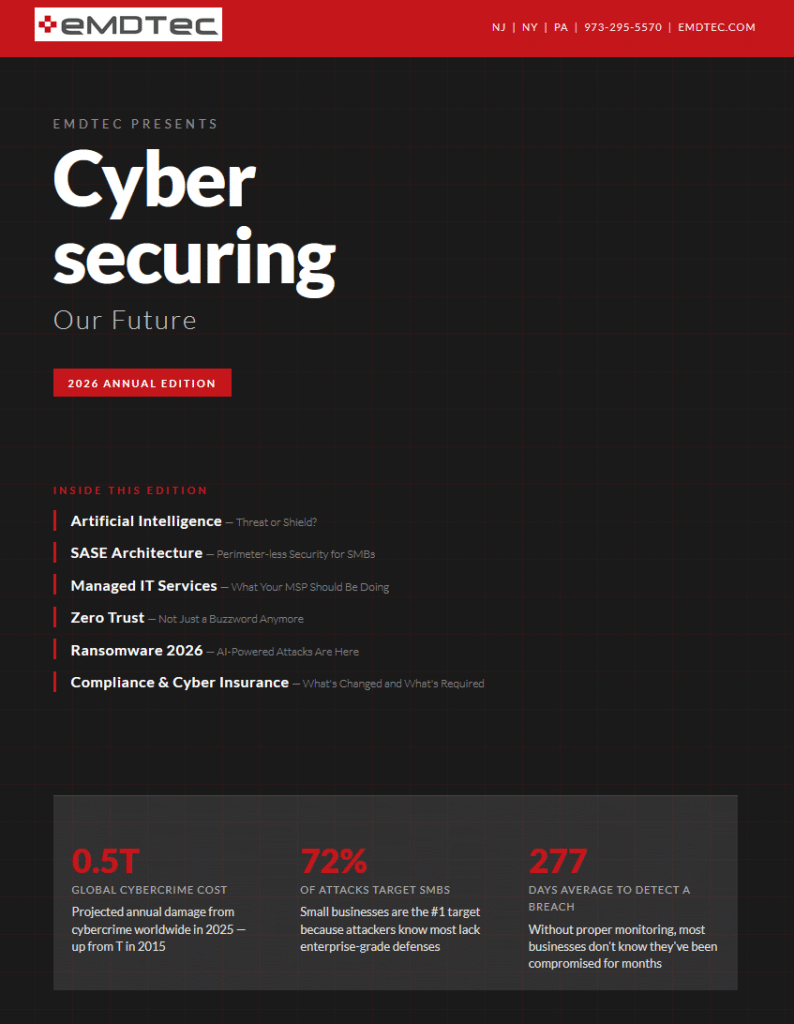
Turning cybersecurity predictions into a real plan means prioritizing, not buying every tool on a vendor’s list. For most small businesses, the order of operations looks like this: lock down identity first (MFA everywhere, especially email and remote access), confirm backups actually restore rather than just run, put a written incident response plan in front of your team, and only then look at emerging tools like AI-driven monitoring or quantum-ready encryption.
If you’re also rolling out AI tools internally, pair this with a clear usage policy — our AI policy playbook covers the rules worth setting before employees start experimenting on their own.
The common thread across every one of these cybersecurity predictions is timing: businesses that act on them early spend less money and lose less sleep than businesses that wait for a headline to force the decision.
Cybersecurity Predictions Mistakes Small Businesses Still Make
- Treating cybersecurity as an IT-only problem instead of a business risk the whole leadership team owns
- Waiting for a close call or an actual incident before testing the response plan
- Skipping vendor and supply chain risk because the vendor is small or familiar
- Assuming last year’s training covered this year’s threats
None of these mistakes are complicated to fix, but they all take a deliberate decision to prioritize them before something forces the issue.
A Simple Way to Prioritize These Cybersecurity Predictions
Not every business needs to act on every prediction at the same pace. A useful way to sort them is by how much damage a miss would cause versus how much effort a fix takes right now.
- High damage, low effort: enabling MFA everywhere, testing that backups actually restore, and reviewing who still has access after they’ve left the company
- High damage, higher effort: building a written incident response plan, mapping vendor and supply chain risk, and setting an AI usage policy before employees experiment on their own
- Lower damage, worth tracking: post-quantum cryptography roadmaps and hacktivism exposure tied to your industry or partners
Working through cybersecurity predictions in that order keeps the budget focused on what actually reduces risk this year, rather than spreading thin across every trend at once.
Put These Cybersecurity Predictions to Work for Your Business
Schedule a Free Consultation — Call 973-295-5570
Featured Image Credit: Pexels
Republished with Permission from The Technology Press.