

 Managed IT Services
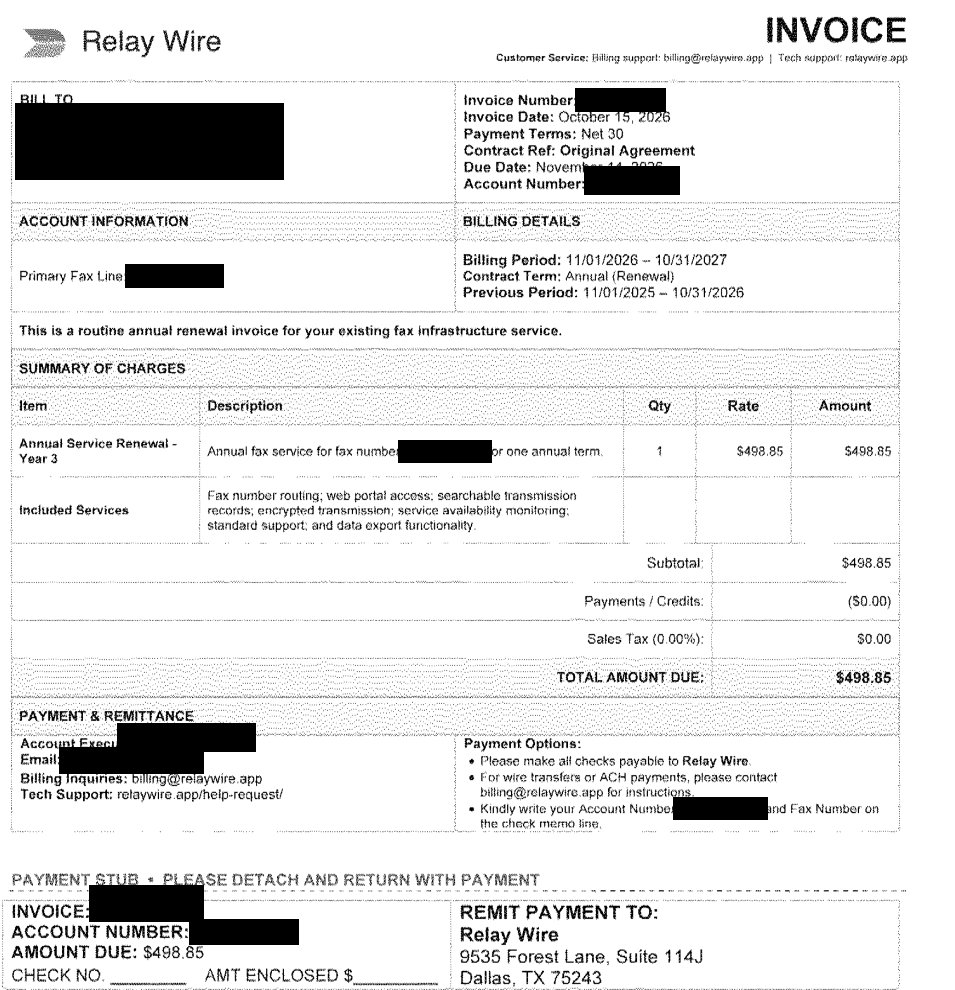
This fall, more than one eMDTec client pulled the same one-page bill off their fax machine from a company called Relay Wire. The copy a New Jersey medical practice received on October 16, 2026 asked for $498.85 to renew “annual fax service” for the practice’s main fax number. It looked routine, with an invoice number, an account number, Net 30 terms and a payment stub to tear off. It was also a fax invoice scam. None of our clients has ever done business with Relay Wire.
We manage these clients’ phones and fax lines, so we knew right away that Relay Wire isn’t their provider. Plenty of front desks and accounts payable teams don’t have that kind of help, and that’s why this scam works. Below we take the real invoice apart (with the client’s details blacked out), show the 7 red flags in it, and explain what to do if a Relay Wire invoice or any other unsolicited fax invoice shows up in your office.
What Is the Relay Wire Fax Invoice Scam?
A fax invoice scam is a fake bill sent by fax for a service the business never ordered. It’s a type of fake invoice scam, also called supplier or vendor invoice fraud. These scammers don’t hack anything or steal passwords. They just send something that looks like a normal bill and count on someone paying it without checking.
The Relay Wire version is built around your fax number. The invoice says it’s a renewal for “fax infrastructure service” on the exact number it was faxed to. The person who pulls the page off the machine sees their own fax number, a reasonable dollar amount and the word “renewal,” and assumes it’s a vendor they already use.
It isn’t just our clients getting it. In July 2026, a business in Albany, NY filed a BBB Scam Tracker report on a Relay Wire fake invoice that matches ours: it came by fax, billed for a year of fax service ($389 in their case), sent payment to a Dallas, TX address, and asked for the fax number on the check memo line. The amount changes from victim to victim. The method doesn’t.
Why Medical Practices Are a Prime Fax Invoice Scam Target
Healthcare still runs on fax, and that’s exactly what a fax invoice scam takes advantage of. Referrals, prior authorizations, lab results, records requests and pharmacy refills all come in by fax every day, so a practice’s fax number is listed everywhere. Any scammer can find it.
- Fax numbers are public. They’re in provider directories, on referral forms, on insurance portals and on the practice website.
- Fax service is easy to fake. A practice may have an analog line from the phone company, an e-fax service, a fax server tied to the EHR, or all three. Few people in the office know which vendor bills for which one.
- Small bills get paid. $498.85 is under the amount most practice managers would question or send to the owner.
- The front desk is busy. Whoever picks up the fax is usually checking in patients at the same time, and a page that looks like a bill goes straight into the “to pay” pile.
Law firms, accounting firms and other professional offices that still fax have the same problem. Any office that has a fax number and pays its own bills can get hit with a fax invoice scam.
7 Red Flags in This Fax Invoice Scam
A quick look at the Relay Wire bill shows a lot that a real vendor would never do. These are the signs of a fax invoice scam to look for on any unsolicited fax invoice.
1. “Contract Ref: Original Agreement” Instead of a Real Contract
The top right of the invoice says Contract Ref: Original Agreement. A real vendor puts a contract number, order number or signed agreement date there. “Original Agreement” sounds official but doesn’t point to anything, because you never signed anything with them. If they can’t name the agreement, there isn’t one.
2. “Renewal – Year 3” With a Made-Up History
The line item says Annual Service Renewal – Year 3, and the bill lists a “Previous Period” of 11/01/2025 – 10/31/2026. That’s meant to make you think you’ve paid them twice already. Search your accounting software, check register and credit card statements for “Relay Wire.” None of our clients had ever paid them.
3. It Tells You It’s Routine
Right in the middle of the page, in bold: “This is a routine annual renewal invoice for your existing fax infrastructure service.” Real invoices don’t need to tell you they’re routine. In a fax invoice scam, that sentence is there to stop you from asking questions.
4. Vague Services That Match Everyone’s Fax Setup
The “Included Services” list (fax routing, web portal access, searchable records, encrypted transmission, monitoring, standard support, data export) is general enough to describe almost any fax service. There’s no plan name, no page count, no user count and no login. A real fax provider’s invoice shows usage you can compare to your own records.
5. Check-Only Payment to an Out-of-State Address
Payment goes by check to a suite in Dallas, TX, with wire and ACH “instructions” only by email request. Real telecom and cloud fax providers bill a card or bank account on file through an online portal. A first-ever bill that asks for a mailed check to a suite number is a classic fax invoice scam warning sign.
6. “Write Your Fax Number on the Check Memo Line”
The invoice asks you to write the account number and your fax number on the check. Your real provider already knows which number it bills. The fax invoice scam uses that detail on purpose. Putting your fax number on a check you send them helps them later, because they can point to it as proof you agreed to the service and use it when they send next year’s “renewal.”
7. Sent by Fax, to the Number It Claims to Service
A fax invoice scam usually arrives this way. Real billing comes by email to your billing contact, through the vendor’s portal, or by mail to your billing address. A bill for your fax line that comes in on that same fax line, from a sender you’ve never heard of, makes no sense. Add the .app web domain and a “tech support” page with no phone number, and it’s clear this isn’t a real vendor.
“If someone is faxing an invoice, it is a scam.”
A CFO eMDTec works with
That rule of thumb holds up remarkably well in 2026. Almost no legitimate vendor sends a first-time bill by fax anymore. If one of your long-standing vendors still faxes invoices, verify any new or unusual one through the contact you already have on file. Treat every other faxed bill as a fax invoice scam until proven otherwise.
Real Fax Bill vs. Fax Invoice Scam: Side by Side
When a bill doesn’t look right, compare it to this table. If most of the right-hand column matches what you’re holding, you’re looking at a fax invoice scam.
| What to check | Real fax provider bill | Fax invoice scam |
|---|---|---|
| Contract reference | Contract or order number, signed date | “Original Agreement” or nothing |
| How it arrives | Email, portal, or mail to your billing contact | Faxed to the number it claims to bill |
| Payment method | Card or bank account on file, online portal | Mailed check to an out-of-state suite |
| Service detail | Plan name, pages, users, a login you use | Generic list of fax features |
| History | Matches payments in your books | Made-up “Year 3” and “Previous Period” |
| Contact options | Phone support and an account manager you can reach | Email and a web form only |
What to Do If You Receive a Relay Wire Invoice
If a Relay Wire invoice or any other suspected fax invoice scam is on your desk now, do these five things:
- Don’t pay it, and don’t call, email or fax them back. Contacting them tells them a real person reads that fax line and puts you on the list for the next round.
- Check who actually provides your fax service. Look in your accounting system for the vendor that bills for your fax line, or ask your IT provider. If you’re an eMDTec client, call us and we’ll tell you in a few minutes.
- Search your payment history for the sender’s name. Check your bank, card and check records for any past payments. If you find one, contact your bank about getting it back.
- Keep the invoice and report it. Report it to the FTC at ReportFraud.ftc.gov and to the BBB Scam Tracker. Then tell everyone in the office who handles bills or the fax machine so they recognize it next time.
- Watch for follow-ups. These scams usually come back with “second notice,” “past due” or “service suspension” letters. Don’t pay those either.
How to Spot a Fake Invoice Before Anyone Pays It
Relay Wire is just one name behind this fax invoice scam. These scammers change company names, amounts and services all the time. The way to stop a fax invoice scam is a simple process that every bill goes through, whoever sent it.
- Keep an approved vendor list. Accounts payable should only pay vendors on the list. Any new vendor gets checked by the practice manager or owner first.
- Match bills to contracts or orders. If you can’t find a signed agreement, an order or an earlier payment, the bill doesn’t get paid.
- Check vendors using contact info you already have. Use the phone number from your own records or the vendor’s real website, never the one printed on the bill.
- Require two people for new payees and changed bank details. Two people signing off stops most invoice fraud, including fake invoices sent by email.
- Know your phone and fax setup. Keep a written list of every phone line, fax number, e-fax account and fax server, with the vendor that bills for each one.
- Train the front desk. Anyone who handles mail or faxes should know these scams exist and where to send anything that looks off.
Invoice fraud and billing scams are on the rise, and the same habits help to protect you against more expensive fraud too. Fake invoices and hijacked vendor email threads cost businesses far more than $498. We cover the email version in our guide on how to spot a scam email, and the AI-powered version in deepfake invoice fraud.
Other Versions of the Fax Invoice Scam to Watch For
Fax service is just one version. The same fax invoice scam setup (a public contact number, a believable service and a small amount) shows up under other names and services:
- Fax archiving or “compliance storage” fees that claim you’re required to keep a copy of your faxes
- Business directory listings that look like a renewal for a yellow-pages ad you never bought
- Domain name or website “renewal” notices from companies that aren’t your registrar
- Toner and office supply bills for shipments you never ordered
- “Annual compliance filing” notices that look like they came from a state agency
Every one of these depends on someone paying a bill without checking it. The vendor checks above stop a fax invoice scam and every one of these the same way.
Invoice Fraud and Billing Scams: Your Compliance Obligations
A $498.85 fax bill isn’t a data breach, but it does show whether your office’s controls are working. Medical practices covered by HIPAA, accounting and tax firms under the FTC Safeguards Rule, and law firms handling client funds are all expected to have documented procedures and trained staff. An office that pays a fake fax invoice probably has other gaps in how it checks vendors and trains people.
Stopping a fax invoice scam is a small part of that. That’s why we add vendor verification and scam awareness to every security risk assessment we run for New Jersey healthcare practices and accounting firms. Fixing these small processes is easier than dealing with the larger fraud attempts that test the same weaknesses.
How eMDTec Shuts Down a Fax Invoice Scam for Clients
Our clients caught this fax invoice scam quickly because they sent it to us before paying it. We already had their phone lines, fax numbers, fax server and every telecom vendor documented, so we could confirm in minutes that Relay Wire had nothing to do with their service. We’ve supported medical practice fax systems for more than 25 years, including the fax servers that connect to CGM eMDs, and we know who bills for what at every client.
Our managed IT services clients get:
- A documented list of every phone line, fax number and telecom contract
- One call to check any suspicious bill, fax or email before anyone pays it
- Security awareness training that includes fake invoices and phishing
- Cybersecurity services that block the email version of this scam before it reaches anyone
Frequently Asked Questions
Is Relay Wire a legitimate fax service company?
We have no evidence that Relay Wire provides fax service to anyone. None of our clients ever signed up with them, and a matching invoice was reported as a fake invoice on the BBB Scam Tracker in July 2026. Treat any Relay Wire invoice as a scam unless the sender can show you a signed agreement and proof of earlier payments.
Do I have to pay an invoice for a service I never ordered?
No reputable company expects payment for a service you never agreed to. If you never signed a contract or approved an order, it’s not a real bill. If you’re worried about a specific situation, talk to your attorney.
What if we already paid a fax invoice scam?
Call your bank right away and ask them to stop or reverse the payment. Then report it to the FTC and the BBB, and check your records for any other payments to the same name. Change your process so new vendors need approval before anyone pays them.
How did the scammers get our fax number?
Business fax numbers are public. They’re on websites, provider directories, referral forms and insurance listings. Getting a fax invoice scam doesn’t mean your systems were hacked. It means your number is on a mailing list.
Where do I report fake invoice scams?
Report fake invoices to the Federal Trade Commission at ReportFraud.ftc.gov and to the BBB Scam Tracker. If you paid with a check or bank transfer, also tell your bank. If the invoice came by mail, you can also report it to the U.S. Postal Inspection Service.
Got a Suspicious Bill? Let Us Check It Before You Pay
The most important thing to remember: never pay a bill for a service nobody in your office remembers ordering. If a fax invoice scam or a strange email bill shows up, send it to us before anyone writes a check. eMDTec helps medical practices and professional offices across New Jersey, New York and Pennsylvania keep their phones, fax lines and vendor payments secure.